
Clarity in the Musée d’Orsay
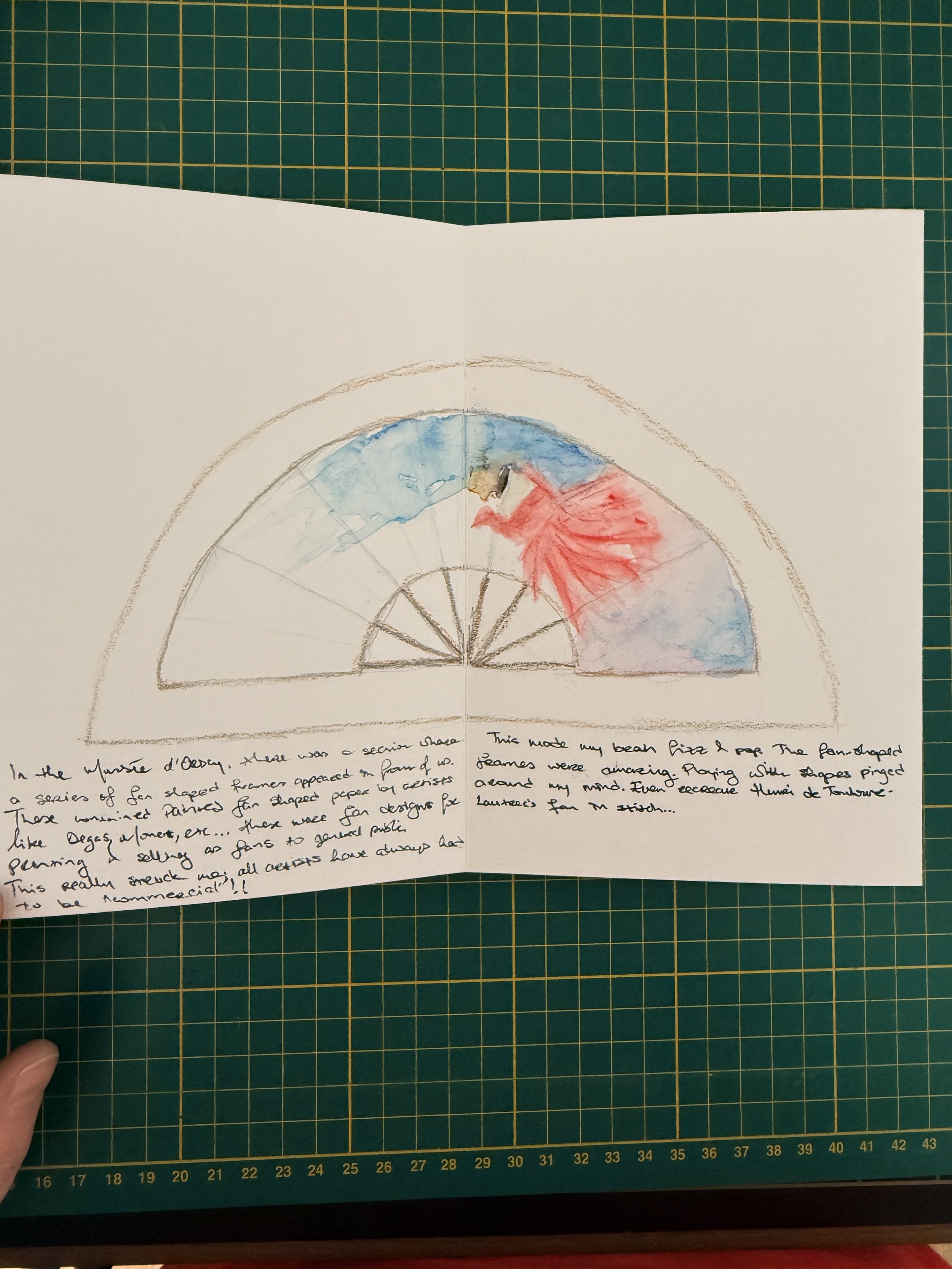
As I said in the last entry, https://www.theannahutchinson.com/studio-journal/paris2026artjournal, one moment in particular has stayed with me.
Between two galleries in the Musée d'Orsay was a small display of works mounted in unusual semi-circular frames. The format caught my attention immediately. I was fascinated by the presentation before I had even registered what the objects were.
Then it clicked.
They weren't drawings in decorative frames. They were fans.
Behind the glass were designs by Impressionist artists including Toulouse-Lautrec, Degas, Renoir, and Monet. Beautiful sketches and paintings created for folding fans. While treated like unique artworks, all were intended to be reproduced and sold, blurring the line between fine art and decorative object.
The realisation was one of those moments of sudden clarity.
These artists we place on pedestals, separating them into the category of "fine art", were also creating work for objects that would live in people's hands and homes. Artworks could be admired in galleries, but they could also be carried, used, owned, and enjoyed in everyday life.
It was a powerful reminder that artists have always needed to make a living.
Somehow, over time, we have created a false divide between commercial work and fine art, as though one compromises the other. Yet here were some of the most celebrated artists in history moving comfortably between both worlds.
The distinction I had unconsciously absorbed suddenly felt much less solid.
Artists have always adapted. They have always produced work that could be sold. They have always found ways to bring their ideas into people's homes and everyday lives.
The fan display didn't just change how I looked at those artists.
It changed how I looked at my own practice.
Paris gave me beautiful architecture, museums, textiles, colours, and sketchbook pages full of experiments. Perhaps, though, the most valuable thing I brought home was permission.
Permission to look more closely.
Permission to follow curiosity.
Permission to stop treating commercial viability and artistic integrity as opposing forces when history shows they never really were.
As artists, we are often encouraged to think in categories. Fine art. Commercial art. Serious work. Sellable work.
Paris reminded me that the boundaries are rarely as fixed as we imagine.
Ax
